
Table of Contents
- Why Private Label Hair Extensions Are Attractive
- The Biggest Mistake: Launching Too Many SKUs
- How Many Products Should a New Hair Brand Launch?
- Choosing Between Tape-In, Clip-In and Weft
- How MOQ Changes Your Launch Budget
- Product Sample Testing
- Packaging Without Overbuilding Inventory
- When to Move From Wholesale to OEM
- FAQ
- Conclusion
Why Private Label Hair Extensions Are Attractive
The global human hair extension market was estimated at $4.88 billion in 2024 by Fortune Business Insights and is projected to reach $10.78 billion by 2032.
Market estimates vary by research firm and market definition, but the broader trend is clear: human hair remains a significant segment of the wider hair enhancement market.
For entrepreneurs, this creates an opportunity.
But starting a hair brand does not mean launching 100 products on day one.
In fact, too many SKUs can create the biggest inventory problem for a new brand.
The Biggest Mistake: Launching Too Many SKUs
Imagine a new brand wants:
5 products
Each product has:
8 colors
Each color has:
4 lengths
That creates:
5 × 8 × 4 = 160 SKUs
Now suppose each SKU requires only 20 units.
The initial inventory becomes:
160 × 20 = 3,200 units
The problem is not the MOQ of one product.
The problem is multiplication.
Products × Colors × Lengths × MOQ = Total Inventory
This is one of the most important calculations for a new private-label hair business.
How Many Products Should a New Hair Brand Launch?
There is no universal number.
But a focused launch is easier to manage.
For example:
Option A — Salon-Focused
- Genius Weft
- Hand-Tied Weft
- Tape-In
Option B — E-Commerce Focused
- Clip-In
- Tape-In
- Ponytail
Option C — Premium Brand
- Genius Weft
- Hand-Tied Weft
- Keratin Bond
The purpose is not to offer every product.
The purpose is to establish a clear product identity.
Choosing Between Tape-In, Clip-In and Weft
Tape-In
Suitable for brands targeting:
- Salon services
- Semi-permanent extensions
- Professional installation
Key selling points include:
- Thin profile
- Fast installation
- Natural blending
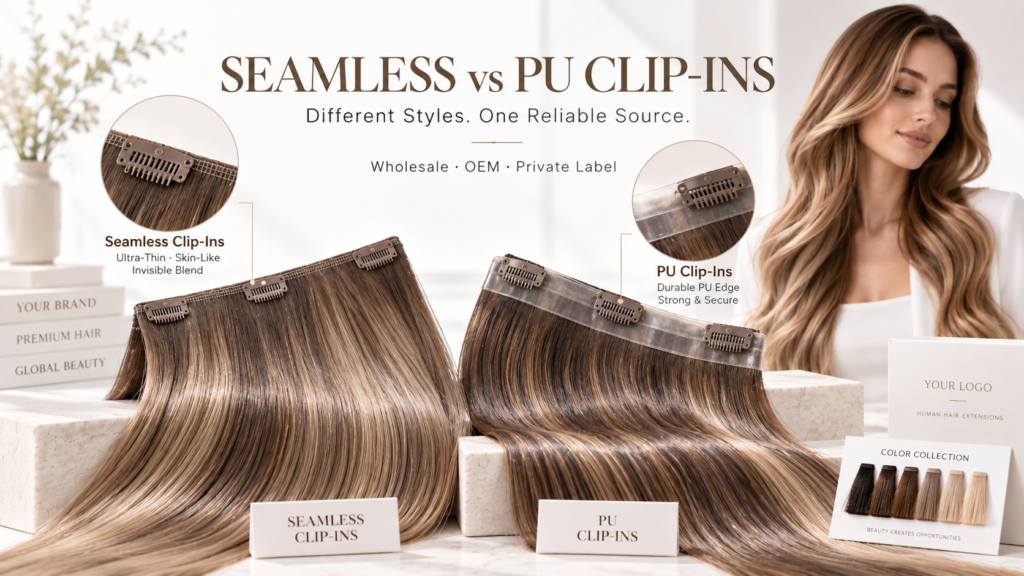
Clip-In
Suitable for:
- E-commerce
- Home users
- Occasional styling
The installation is comparatively simple, making clip-ins attractive for direct-to-consumer businesses.
Genius Weft
Suitable for:
- Professional salons
- Premium extension brands
- Clients seeking a thin weft profile
Its construction is designed around a thin weft structure and can be positioned as a professional salon product.
Hand-Tied Weft
Suitable for:
- Premium salon positioning
- Natural movement
- Lightweight applications
Product selection should therefore follow your target customer rather than simply choosing the product with the highest search volume.
How MOQ Changes Your Launch Budget
MOQ becomes complicated when customization is added.
Your real calculation should be:
Total Initial Inventory = MOQ × Colors × Lengths × Product Types
For example:
100 pieces × 4 colors × 3 lengths = 1,200 pieces
Now add three product types:
1,200 × 3 = 3,600 pieces
This is why understanding MOQ before designing your product catalog is critical.
XC Nova Hair’s existing MOQ guide provides indicative ranges for different products and explains why customized products generally require different production quantities.
Product Sample Testing
Before mass production, test the product.
A professional sample checklist should include:
Hair Quality
- Softness
- Texture
- Shedding
- Tangling
Specification
- Length
- Weight
- Color
- Density
Construction
- Weft
- Tape
- Clip
- Bond
Customer Experience
Ask:
Would I be comfortable selling this product under my brand name?
If the answer is not yes, don’t move to mass production.
Packaging Without Overbuilding Inventory
Packaging can also create MOQ problems.
Suppose you design:
- 8 colors
- 4 lengths
- 3 product types
If each variation needs separate packaging, your packaging inventory can become almost as complicated as the hair inventory.
A smarter approach is to standardize parts of the packaging.
For example:
Universal Brand Box
Color Label
Length Label
Product Label
This can reduce the number of completely unique packaging components.
When to Move From Wholesale to OEM
A new business does not necessarily need full OEM production immediately.
A practical progression can be:
Stage 1
Wholesale products
↓
Stage 2
Custom packaging
↓
Stage 3
Private label
↓
Stage 4
Custom colors
↓
Stage 5
Full OEM
This allows the business to learn what customers actually buy before investing heavily in product development.
For detailed supplier selection, see the XC Nova Hair Wholesale Hair Extensions Guide.
The 30-Day Launch Framework
A new brand can structure its first month around four stages.
Week 1 — Product Research
Identify:
- Target customer
- Product category
- Price position
- Competitors
Week 2 — Samples
Order samples and test:
- Quality
- Color
- Weight
- Construction
Week 3 — Branding
Finalize:
- Logo
- Packaging
- Labels
- Product names
Week 4 — Production Planning
Confirm:
- MOQ
- Lead time
- Packaging
- Shipping
- QC
Only then approve bulk production.
FAQ
Can I start a private-label hair brand with a small order?
Yes, depending on the supplier and customization requirements.
How many products should I launch?
There is no universal number. A focused collection can reduce inventory complexity.
Should I customize colors immediately?
Only if custom colors are important to your target market. Otherwise, start with proven colors and expand later.
Should I choose OEM or private label?
Private label is generally simpler when launching a brand. Full OEM becomes more useful when the business needs unique specifications.
Conclusion
Building a Private Label Hair Extensions brand is not simply about putting a logo on a box.
The real challenge is controlling:
Product Selection + SKU Count + MOQ + Inventory + Quality + Branding
The best starting point is usually not the largest product catalog.
It is a focused collection that can be tested, measured, and expanded.
Once demand is validated, the brand can move toward deeper customization and OEM manufacturing.